
This year’s October arc was something else, as two big names broke their covers with their hypercar releases – McLaren W1 on 6th October and Ferrari’s long-awaited F80 on 17th October.
Many car enthusiasts see the release as a natural war, and it’s the right time for power-hungry supercar buyers to take sides as the hypercar war is on.
“We’ve reached the top,” says Gianmaria Fulgenzi, head of product development at the company. “By marrying our technology and computer programs, we’re able to push harder than ever before. We set new standards. How the car cuts through the air, carves through a corner, and takes off down the straight. this is a car you can drive all out.
To whatever level you’re comfortable with. You feel instantly how the car responds. Sure, the computer programs do their part. But you won’t feel them working. You’ll just feel as though you have always known this car. A prolongation of yourself.”
Even though McLaren claims that their new W1 is superior, Ferrari does not appear unduly concerned about it. As Fulgenzi himself says, just how all those elements interlink is their USP, and the best of every available component is available to Ferrari to do just that.
What’s New?
Being a long-awaited successor to the legendary LaFerrari, it doesn’t disappoint. The model comes with 120 degrees between two banks, turbocharged induction, 627 lb-ft, 9,200 RPM, 9.5:1 compression ratio, active wings, one ton of downforce at 155 mph, and 888 hp with an extra 296 all-electric horsepower.
The jaw-dropping 1186 hp power performance is sufficient to give nightmares to the new 2025 Corvette ZR1, McLaren W1, miles ahead of any Huracan or Revuelto, and every Ferrari competitor coming in this league.
Newer Technology has also been added, like the computer-generated model that uses the sensor- FIVE (Ferrari Integrated Vehicle Estimator). This computerized model uses sensors to process the input data and make necessary adjustments to all the car components.
Another distinguishable feature of the F80 to consider here is that the engine produces a Specific Output, which means more power per cubic centimeter of displacement and more power per liter.
Think of the concept of specific output this way. This little, fierce turbocharged engine is half the size and half the cylinders of the Ferrari V12, yet able to produce more power. Less yet powerful engines, I would say.
Better than LaFerrari?
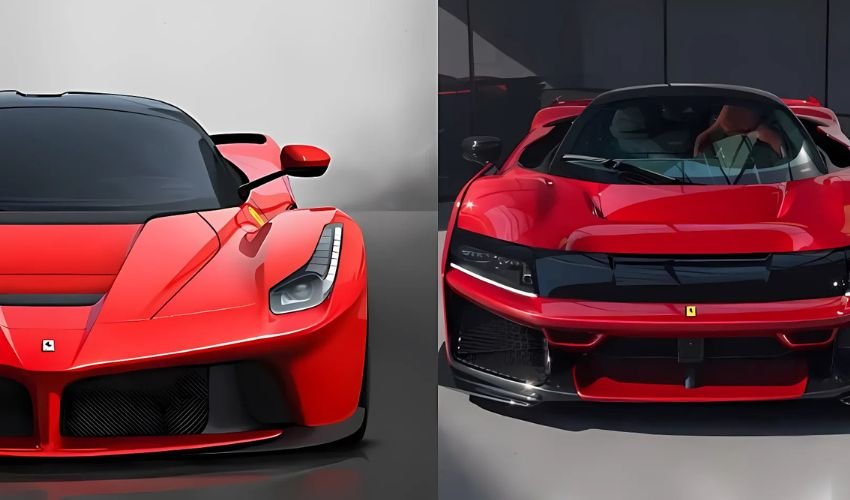
No doubt, LaFerrari and F80 are both high-performance hybrid supercars. But as you might expect, the F80 is ahead with the pinnacle of advanced technology that no Ferrari has used before, not to mention the F80’s unbelievable aero.
Lafarrari comes with a signature 6.3-liter V12 engine producing 949 horsepower, whereas F80 has a 3-liter V6 twin-turbo power engine producing a jaw-dropping 1100 hp and 730 lb-ft torque. LaFerrari can go from 0-60 in just 2.2 seconds while F80 crosses the 0-62 in just 2.1 seconds.
The LaFerrari comes with advanced aerodynamics and an active spoiler. For the F80, the brand uses extreme aerodynamics and active wings.
LaFerrari has carbon-ceramic Brembo brake discs at the front and rear, while the carbon brakes of the F80 are three times better at dissipating heat and twice as strong as any other vehicle in the Ferrari lineup.
Coming on to design, LaFerrari takes this one. LaFerrari’s design is timeless and still to be surpassed. F80 focuses more on radical design, and to be honest, it’s good but not what you expect from a Ferrari.
You May Also Read: Greatest Ferrari Convertibles
How’s the Design?
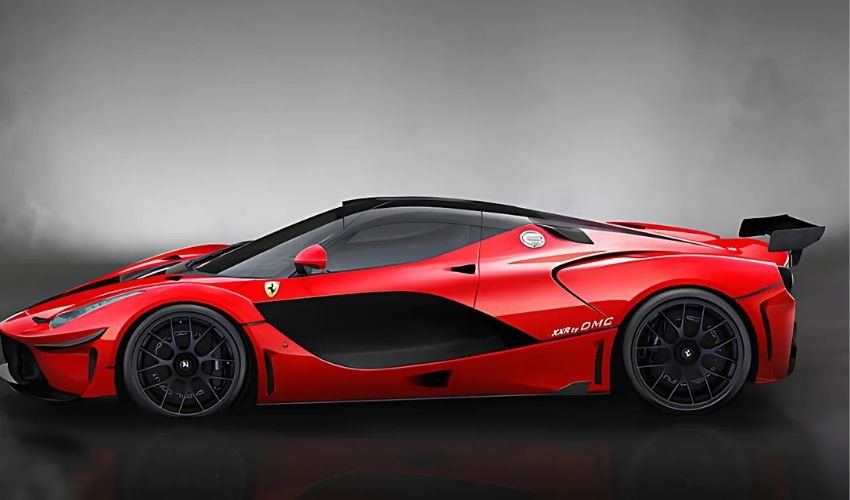
The prime purpose of anyone owning a Ferrari, whether it’s old or new– is showing off. That’s the prime reason vintage cars like the Ferrari 250 GTO are being sold for seven figures.
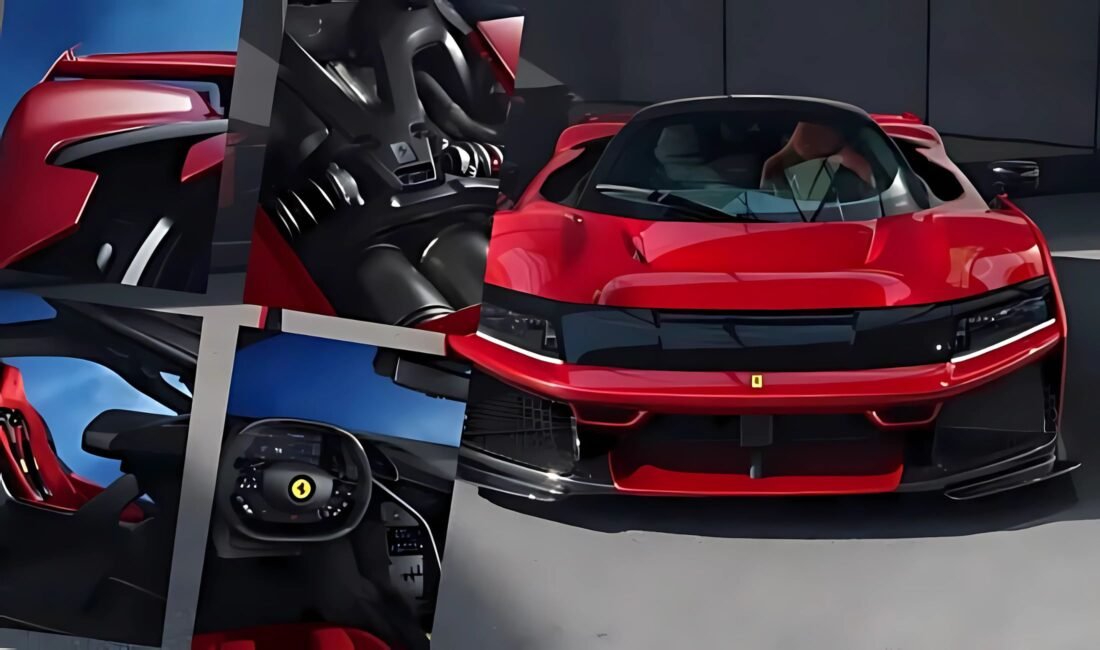
The aggressive front grille design, carbon fiber body, and high-end exterior appearance give head turns with the futuristic aerodynamics, which are somewhat similar to the legendary F40 from four decades ago.
To give a light, delete appearance, the headlamps are hidden in the visor element. While comparing the roof with its predecessor LaFerrari is five centimeters lower on this model. The staggered alloy wheels measured 19 inches at the front and 20 inches at the rear. A massive rear wing has also been added, which has nothing to do with the acrobatics, while the one on the W1 moves upwards and up.
Shifting the focus to the interior, other than being a 2-seater car, the car gives a vibe of a single-seater, which is defined by the brand as a 1+ layout. Having said that, the entire cockpit with the control panel solely focuses on the one behind the wheels.
The steering wheel is another bespoke addition to the design, and the unique integration of innovation and technology with the physical buttons on the side spokes. The brand plans to integrate, to a certain degree similar driving wheel in future models.
Ferrari F80’s V8 Engine
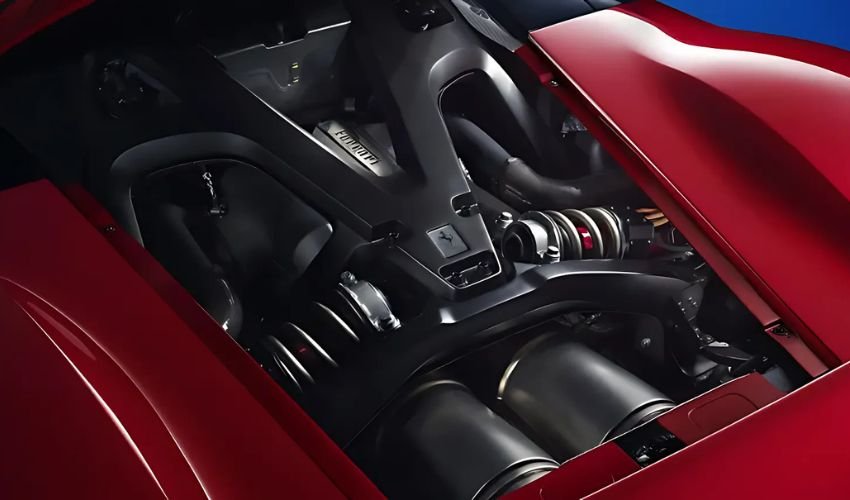
Under the hood, you’ll not find the traditional V12 in the F80, instead, it features a twin-turbo V6 having a hybrid powertrain, along with three electric motors producing a combined amount of 1184 horsepower.
Its performance is out of this world: 0-100 km/h in only 2.15 seconds, with a top speed of 350 km/h, thus considered the most powerful Ferrari ever built. The design of the vehicle itself brings significant Formula 1 technology, having the most advanced active aerodynamic system, guaranteeing more than 1,000 kg of downforce at high speed on the ground for exceptional stability and hold.
It offers an all-wheel drive system with two electric motors on the front axle- the third engine is on the rear. With these engines, the car has an edge in off-the-line acceleration. F80 also offers three driving modes – Hybrid, performance, and Qualify.
As per the art term, F80 is a mixed media as the central hub of the chassis is made of carbon fiber and other alloys. Big screws like titanium screws are attached to the tub. The bodywork of the vehicle is solely made of carbon fiber and aluminum in its build, keeping the weight low while ensuring better performance dynamics.
You May Like: Cheapest Ferraris
Pricing and What Falls Flat in F80?
Uncovered just two weeks ago, there are mixed reviews for F80. Some of the reception’s problematic features of the Ferrari F80 have raised several eyebrows in the automobile world.
After setting its base price at $3.9 million, the F80 was already an exclusive offering limited to just 799 units. But the market has quickly pushed that figure even higher-with one German dealer listing a build slot for approximately $6.3 million as an incredibly high $2.5 million markup.
The extreme price it has demanded has also brought about criticism, particularly when compared with competition from the likes of McLaren.
The F80’s design also disappointed me, as did many car reviewers. It just doesn’t carry Ferrari’s signature style and does not feel like a Ferrari from a distance. The changeover to a hybrid V6 powerplant, though technologically advanced, has also been questioned by purists who like Ferrari’s traditional V8 and V12 engines. The V6 engine sound is also not that ear-pleasing either.
Final Words
As the release of the F80 is new, there is no more information about the flagship vehicle, like specifications, range, charging, battery life, warranty, and fuel economy.
No doubt, the F80 is a powerful, classy, high-end vehicle with a 3.0-litre hybrid engine that can produce almost 1200 hp. This acceleration makes it one of the in-demand vehicles. For some, it doesn’t align with their expectation; however, saying anything today is just someone’s perspective, not the reality.
Engaging wealthy customers with the high-performance, limited-edition F80 is a good tactic to create hype for the brand.