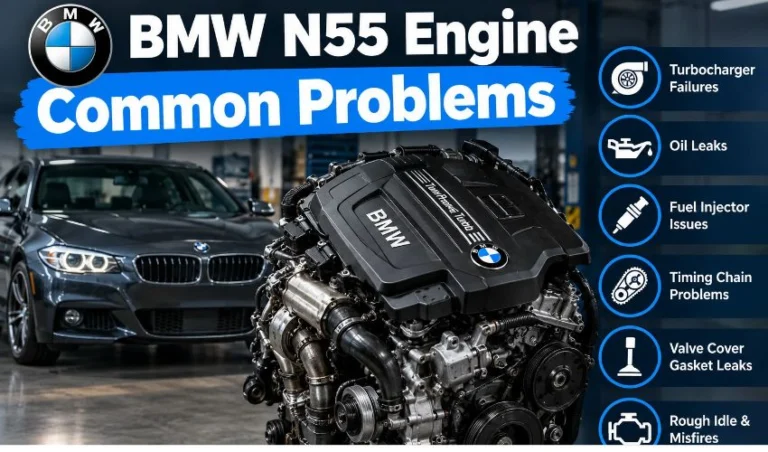
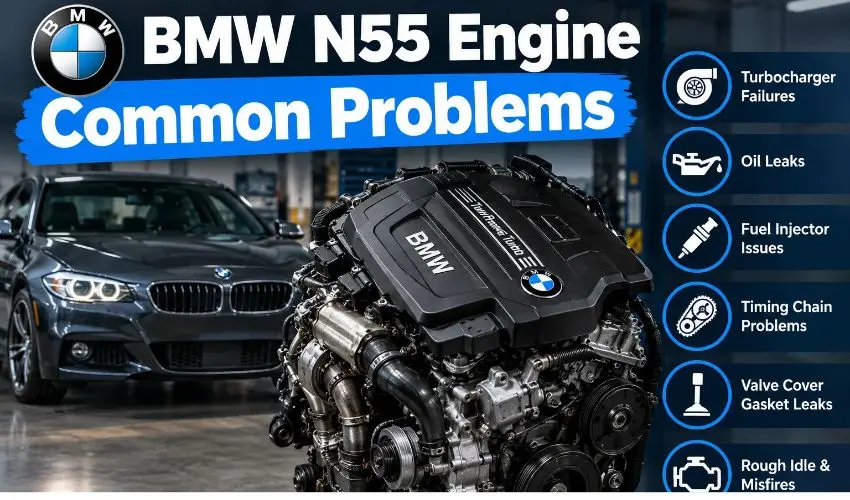
Ask ten BMW owners if the N55 is reliable and you will hear two confident answers. Some drive theirs past 150,000 miles with a short list of repairs. Others are on their third cooling system repair before 80,000. The strange part is that both groups are telling the truth.
The problem is not with the engine, it holds itself pretty well. The parts bolted to it, and the parts around it, are where the money goes. That’s why most N55 problems long-term owners faced come from the parts, not the core engine itself.
The engine was introduced around 2009 and replaced the twin-turbo N54 in cars like the 335i, 535i, 135i and 640i. It also showed up in the X3, X5, X6, Z4 and the M235i and M2. The B58 took over from 2016 onward.
In this article, we’ll highlight the common problems most owners face with N55 and don’t worry, this article actually holds data rather than blunt claims or generic listicle.
- Quick Answer: Is the N55 Reliable Long Term?
- How Many Miles Can an N55 Last?
- Common BMW N55 Problems
- Stock vs Tuned N55 Reliability
- RWD vs xDrive: Same Engine, Different Bills
- How Much Does N55 Maintenance Cost?
- How to Make an N55 Last Longer
- What N55 Owners Say About Long-Term Reliability
- Should I Still Get A BMW With The N55 Engine?
- Frequently Asked Questions - N55 Common Problems
Quick Answer: Is the N55 Reliable Long Term?
BMW N55 Reliability at a Glance
The engine holds up. The parts around it cost the money.
Is the engine durable?
How far can it go?
Biggest weak spots
Better than the N54?
Cheapest to own?
How Many Miles Can an N55 Last?
With decent maintenance, 150,000 miles is a fair expectation. Plenty of owners report more, and most of them mention the same habits: short oil intervals, fixing leaks early and replacing plastic cooling parts before they fail.
Think of these mileages as checkpoints, not a repair schedule. Nothing here is guaranteed to fail at a given number.
| Mileage | Service |
|---|---|
| Under 50,000 | Charge pipe, oil changes, any boost leaks |
| 50,000 to 75,000 | Valve cover, oil filter housing gasket, spark plugs and coils |
| 75,000 to 100,000 | Water pump and thermostat, hoses, expansion tank |
| 100,000 to 150,000 | Everything above again, plus VANOS solenoids and turbo condition |
| 150,000 and up | Paperwork. A documented history beats low miles |
What shortens the life of an N55:
- Following BMW’s very long oil interval
- Hard driving on a cold engine
- Stacking tune upgrades without fixing weak parts first
- Ignoring small coolant or oil leaks
- A car with no service records
Also Read: Audi vs. BMW vs. Mercedes
Common BMW N55 Problems
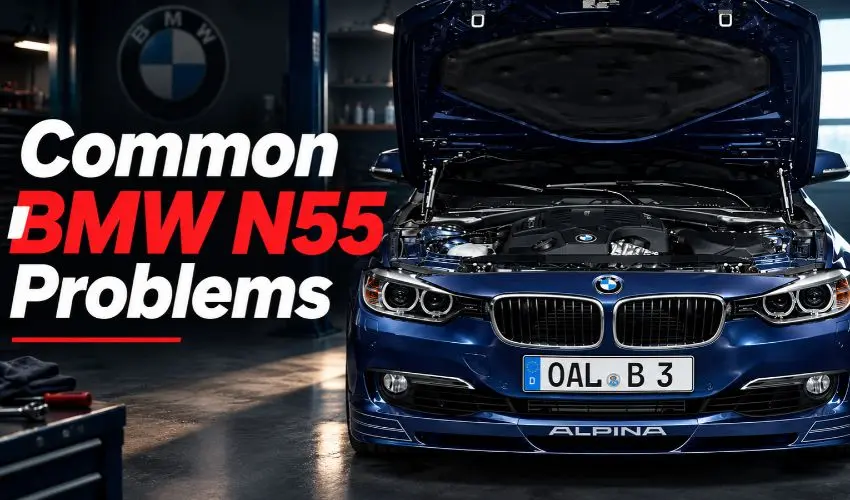
The BMW N55 engine is generally reliable, but it is prone to plastic charge pipe failures, oil leaks from aging gaskets, and a failing electric water pump.
Worn spark plugs and coils, sticky VANOS solenoids and aging injectors come next, and tuned cars see most of them sooner. None of these are rare, but they are mostly wear and leaks, not engine failure. The charge pipe is the first thing I would check on any car, since it is cheap to fix and expensive to ignore.
Below is every N55 common problem in detail…
Charge Pipe Failure
This is the first thing I would check on any N55. The factory pipe is plastic, and it handles heat and boost pressure every time you press the pedal. Tuning shops put its life at roughly 30,000 to 70,000 miles on stock boost.
More boost means more heat, and heat is what cracks it. The worse part is what happens next. A split pipe can damage the TMAP sensor, which reads intake air pressure and temperature. A cheap pipe then turns into a pipe, a sensor and a car that runs strangely.
Watch for sudden power loss, a hiss under boost and a check engine light. The usual fix is an aluminum pipe, ideally fitted before the plastic one gives up.
Valve Cover and Gasket Leaks
The N55 valve cover is plastic, and the PCV system is built into it. The normal advice is to replace the cover and gasket together, not just the gasket.
Some tuning shops go straight to an aluminum cover. You can get the cover, gasket and hardware fixed at about $389 in parts. An OEM-style set is listed at about $389. Labor is extra.
If you leave a leak, expect a burning oil smell, smoke from the engine bay and oil near the front of the engine. Oil dripping onto hot parts like the manifolds is how a small leak becomes a bigger bill.
Is this an N55 problem or a BMW problem? Both. Leaking valve covers show up on the N54 and N52 too. The N55 is more annoying because the PCV parts sit in the cover.
Oil Filter Housing Gasket (OFHG)
The gasket costs about $15 and the job is still a pain. Once it hardens, it leaks oil, and the drips can reach belts and other parts below. A neglected housing can also let oil and coolant mix.
Do not ignore it. Around 100,000 miles, some specialists replace the whole housing and not just the gasket.
Electric Water Pump Failure
The N55 uses an electric pump that the computer controls. The weak point is the composite impeller, which is plastic, and BMW’s weight saving shows here. These pumps can fail with little warning.
Most vendors suggest replacing the pump between 60,000 and 80,000 miles. Some owners report failures as early as 30,000. Those sellers profit from pump sales, so use their numbers as a guide.
The signs are a coolant warning, a low coolant light or an overheating message. An OEM-spec pump with a metal impeller costs around $350 from one vendor. Check the listing confirms the metal impeller. Replace the thermostat at the same time to save labor.
Cooling System, Oil Cooler and Thermostat
The plastic expansion tank, hoses and fittings age out. If your coolant keeps dropping, something is leaking. Finding it early is cheap, and finding it after an overheat is not.
The stock oil cooler is fine for daily driving. On a track or in hard use, oil temperatures climb. Tuning shops fix this with a bigger bolt-on cooler, or with a thermostat that opens earlier than the stock one. The thermostat is the cheaper route if you want to keep the stock cooler.
VANOS Solenoids
The VANOS solenoids control valve timing. Dirty or weak ones cause rough running, loss of power and a check engine light. Cleaning or replacing them usually fixes it, and it is not a major repair.
Ignition Coils and Spark Plugs
The N55 goes through plugs and coils faster than most owners expect. A rough idle under load, hesitation and a flashing check engine light all point here.
On a tuned car, tuners usually move to one step colder plugs, and they say that matters most past about 500 horsepower. They also suggest changing plugs every 15,000 to 25,000 miles on those cars. A stock car can go longer.
For coils, some owners swap the OEM Bosch coils for Eldor ones at about $27 each, and tuners say they hold up at high power.
Fuel System
The stock fuel system is the main limit for anyone chasing power. It has a low-pressure pump, a high-pressure pump and solenoid injectors. Tuners put the ceiling in the mid-400 horsepower range, and they say pushing past it shortens life.
They also say the early parts were not fully sorted until about 2013, so the build date matters when you shop. The injectors are the part to watch. A stuck-open injector floods a cylinder with fuel, and it is serious when it happens. Replace them on time if the car is tuned.
Timing Chain and Guides
The N55 uses a timing chain, not a belt, and it has a forged crank, so the bottom end is solid. The weaker part is the plastic rail guides and the hydraulic tensioner. Tuners say higher boost puts extra stress on them.
This is less common than the other problems here. If you plan to tune the car, upgrading the tensioner and the guides while the engine is open is cheap insurance.
Turbocharger Problems
The single twin-scroll turbo is not a widespread failure point. When people talk about turbo trouble, it is usually a boost leak, a wastegate rattle or an oil seal wearing out. Whining noises and blue smoke from the exhaust are the ones to take seriously.
Stock turbos live longer when the oil is clean and the engine warms up before hard driving. Tuned cars ask more of the same hardware.
Stock vs Tuned N55 Reliability
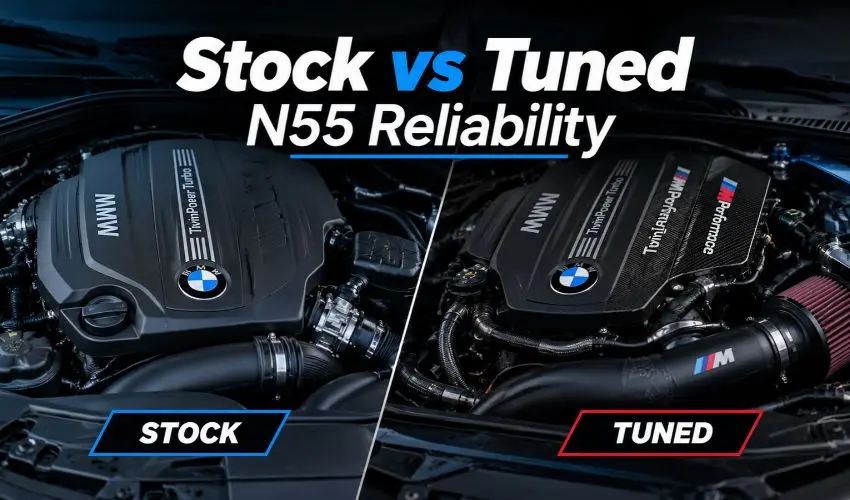
A stock N55 is the safer buy. Its usual problems are wear and leaks, and you can plan for those.
A tuned one is a different car. More boost means more heat, and tuning shops say that is what cracks the charge pipe, wears out plugs and coils faster and pushes the stock fuel system toward its limit, which they put in the mid-400 horsepower range. Tuners also say the timing chain guides and tensioner see more stress at higher boost.
None of that makes a tuned N55 a bad car. Owners do report high mileage on tuned cars, but those cars usually had colder plugs, upgraded coils, a stronger charge pipe and shorter oil intervals. I would only trust a tuned car if the seller can show which tune was used, who installed it and what supporting parts were added. If the seller has no records, treat it as a stock car with hidden problems and price it that way.
RWD vs xDrive: Same Engine, Different Bills
An xDrive car has extra parts that are not the engine, and they can cost real money. That is why someone can have a healthy N55 and a very expensive repair bill.
- Transfer case: the actuator and the case itself are known to cause trouble on some cars.
- Differentials: front and rear units can leak or whine, and fluid changes are often skipped.
- Extra service: more fluids, more seals, more things to check.
If you want the cheapest long-term ownership, a rear-drive car has fewer parts to go wrong.
How Much Does N55 Maintenance Cost?
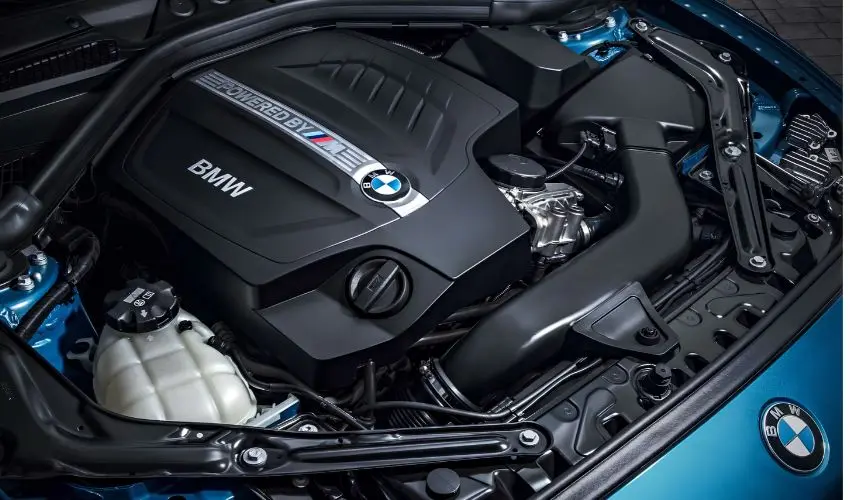
Expect to spend roughly $500 to $1,500 a year to keep an N55 BMW healthy at an independent shop, with routine service at the low end and repairs pushing it higher. Oil changes, filters and coolant checks are the cheap part – change the oil every 5,000 to 7,500 miles, not at BMW’s 15,000. Spark plugs and coils come up more often than on most engines, especially on tuned cars.
Routine Maintenance
- Oil and filter: many specialists suggest every 5,000 to 7,500 miles, not BMW’s 15,000.
- Spark plugs and coils: replace as needed. Plugs often go sooner on tuned cars.
- Coolant: check the level often and follow the manual for the change interval.
- Belts and filters: inspect them at every service.
N55 Common Repair Costs
I could only verify parts prices from sellers. Labor is where bills grow, and it varies a lot by shop and location. Use these as a starting point, then get quotes from independent BMW specialists.
| Repair | Est. Cost |
|---|---|
| OFHG gasket | About $15 for the gasket. Labor is the bigger cost |
| Valve cover and gasket | About $389 in parts |
| Electric water pump | About $330 for a pump. Add thermostat and labor |
| Charge pipe (aluminum) | Usually cheaper than most items here. Check current prices |
| Turbocharger | The expensive one. Quotes vary widely |
How to Make an N55 Last Longer
- Change the oil more often than BMW says, with the correct spec.
- Do not ignore coolant or oil leaks.
- Replace the plastic charge pipe before it fails.
- Replace worn plugs and coils.
- Let the engine warm up before you drive it hard.
- Let it cool down after extreme use.
- Replace the water pump and thermostat on age or mileage, not after a breakdown.
- Service the transmission and, on xDrive, the differentials and transfer case.
- Be careful with aggressive tunes.
- Keep every receipt.
What N55 Owners Say About Long-Term Reliability

When covering this topic, I went through tons of forums and public discussions and most owners do not agree on everything. Forums attract people with either a very good or a very bad story, and nobody writes a post to say their car has been fine. That is survivorship bias, and it works in both directions.
That is why I would weigh forum reports against other sources like BMW technical documentation, recalls and service bulletins, and repair databases. Where they agree, you can trust the pattern, where they disagree, be careful.
Owners mostly describe the N55 as a good engine with a short list of known chores. Most say it just needs good oil, regular changes and the usual cooling parts, with the plastic charge pipe the likely weak spot, and another drove a 135i for over three years with no issues.
TorqueCars calls the engine highly reliable, then lists fuel pump and injector wear, boost pipe leaks, oil leaks, the water pump and wastegate wear, and says later engines had fewer problems. On xDrive cars, an F15 X5 owner relayed that a leaking oil pan gasket around 80,000 miles was common, and the job is bigger because of access around the front differential.
Others who have worked on both engines say an unmodified N55 is the easier daily driver compared with the N54. The complaints match what the repair side shows.
Should I Still Get A BMW With The N55 Engine?
Yes! The N55 is a strong engine. It gives you real power, a smooth inline-six feel and decent fuel economy. It also has a few known weak spots, and those are cheap to deal with when you catch them early. Stick to the service schedule, fix leaks as they appear and the engine will last. BMW and ALPINA built it from 2009 to 2018, so there are plenty of cars to choose from, in many shapes and sizes.
Here are the specifications of the BMW N55 engine:
General Specs and Features
| Specification | N55 |
|---|---|
| Engine Type | Inline-6 |
| Displacement | 2,979 cc (181.8 cu in) |
| Bore | 84 mm (3.31 in) |
| Stroke | 89.6 mm (3.53 in) |
| Compression Ratio | 10.2:1 |
| Redline | 7,000 rpm |
| Fuel System | Direct injection |
| Turbocharger | Single TwinScroll turbocharger |
| Intercooler | Air-to-air |
Power and Torque
| N55 Variant | Power | Power RPM |
|---|---|---|
| N55B30M0 | 225 kW (302 hp) | 5,800 rpm |
| N55B30 | 235 kW (315 hp) | 5,800 rpm |
| N55B30O0 | 240 kW (322 hp) | 5,800 rpm |
| N55HP | 250 kW (335 hp) | 5,800 rpm |
| N55B30T0 | 265 kW (355 bhp) | 5,255–6,000 rpm |
| N55B30T0 | 272 kW (365 bhp) | 6,500 rpm |
| ALPINA | 301 kW (404 bhp) | 5,500–6,250 rpm |
| ALPINA | 324 kW (434 bhp) | 5,500–6,250 rpm |
| ALPINA | 332 kW (445 bhp) | 5,500–6,250 rpm |
Frequently Asked Questions – N55 Common Problems
The most common BMW N55 problems are a cracking plastic charge pipe, leaking valve cover and oil filter housing gaskets, and a failing electric water pump.
They are uncommon. When they happen, it is usually the Valvetronic motor or its sensor, and you will see a rough idle, reduced power or a check engine light.
Yes, if it has full service records and the cooling and gasket work has been done. A high-mileage car with no history is a gamble.
Yes, at the right price. Budget for the water pump, thermostat and gaskets if they have not been replaced, and pay for a specialist inspection first.
Roughly $300 to $1,500 for most common repairs, like the charge pipe, gaskets or water pump. A turbo costs far more, and labor rates vary by shop.