
A well-maintained Toyota Camry will comfortably clear 200,000 miles, and pushing past 300,000 is realistic if you stay ahead of basic maintenance. The V6 and hybrid versions tend to go even further than the standard four-cylinder. None of that is luck. It comes down to a handful of engines Toyota kept refining instead of replacing every few years.
For context, the average car on the road today has roughly an 8.6% chance of reaching 250,000 miles. The average vehicle has only an 8.6 percent chance of lasting 250,000 miles or more. The Camry beats that by a wide margin, and the numbers below show exactly how much.
- Toyota Camry Lifespan: The Short Answer
- Toyota Camry Generations: A Year-by-Year Breakdown
- Engine Longevity: Which Camry Engine Lasts Longest
- Camry Years to Avoid vs. Best Years
- Common Problems With the Camry
- Camry Hybrid Battery: The Real Number to Watch
- Mileage vs. Condition: Which Matters More When Buying Used
- Maintenance That Actually Extends Lifespan
- Is a High-Mileage Camry Worth Buying?
- Camry vs. Accord vs. Altima: Does It Actually Last Longer?
- Can a Camry Reach 300,000 or 500,000 Miles?
- Bottom Line
- Frequently Asked Questions
Toyota Camry Lifespan: The Short Answer
iSeeCars built its lifespan model from over 300 million data points, and gas and V6 Camrys average about 172,479 miles, or 13.1 years, on the road. The Toyota Camry has an average lifespan of 172,479 miles or about 13.1 years, and these same data points show it is typically driven 11,759 miles a year during its first 10 years of use, with a 31.8 percent chance of reaching at least 200,000 miles, contributing to a 7.6 out of 10 reliability rating that ranks it the most reliable midsize car.
The Camry Hybrid does even better and has an average lifespan of 181,736 miles or about 14.6 years. It is typically driven 11,286 miles a year during its first 10 years, and has a 37.9 percent chance of reaching at least 200,000 miles, giving it a 7.8 out of 10 reliability rating.
These are averages across every Camry on the road, including ones that never saw a scheduled oil change. A Camry that actually gets serviced on time routinely beats both figures.
Also Read: How Many Miles Will Toyota Prius Last
Toyota Camry Generations: A Year-by-Year Breakdown
| Generation | Years | Known Strengths | Known Weak Points | Realistic Mileage Ceiling |
|---|---|---|---|---|
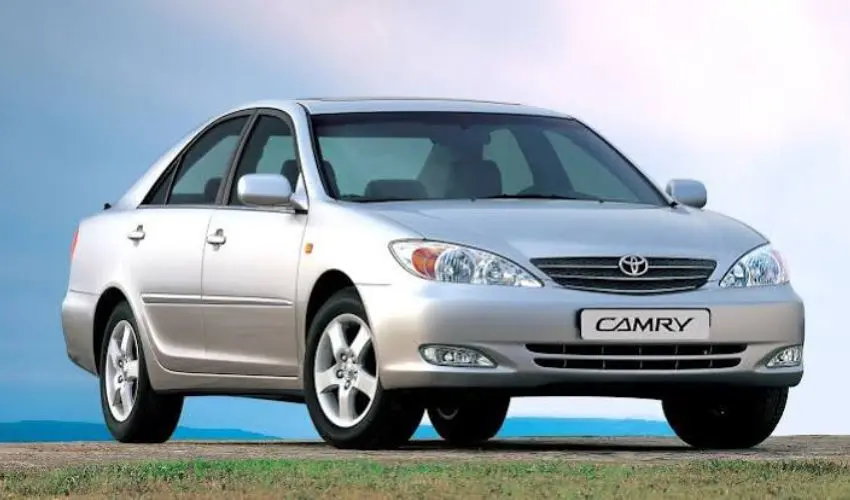
| XV30 (5th gen) | 2002-2006 | Simple, well-understood engines; strong resale | Early oil consumption reports begin late in this run | 200,000-250,000 |
| XV40 (6th gen) | 2007-2011 | Available V6, first Camry Hybrid | 2AZ-FE oil burning (worst 2007-2009), melting dashboard | 200,000-250,000, higher on V6/Hybrid |
| XV50 (7th gen) | 2012-2017 | 2AR-FE, one of the cleanest engines Camry has used, fully sorted by 2015-2017 | Shift hesitation reported on the 6-speed, mostly 2012-2015 | 250,000-plus |
| XV70 (8th gen) | 2018-2024 | Dynamic Force engines, available 301-hp V6, standard TSS 2.5+ from 2021 | 2018 piston recall (narrow window), early 8-speed shift complaints | 250,000-plus once past 2018 |
| XV80 (9th gen) | 2025-present | All-hybrid, up to 53 mpg combined | Simply too new for long-term data |
Engine Longevity: Which Camry Engine Lasts Longest
The Camry has run three distinct engine families since 2002, and they don’t all age the same.`
2.4L four-cylinder, 2AZ-FE (2002-2011)
This is the engine behind the Camry’s one real reliability scar. Some 2006-2011 units, worst in 2007-2009, developed piston ring wear that let them burn oil at an alarming rate. The engine can burn a quart of oil every 1,000 to 1,200 miles without any visible external leaks, and owners frequently report no adequate warning before the oil level drops critically low.
Toyota eventually responded and extended the warranty period for the affected pistons and oil control rings, but these engines can still rack up big mileage. They need closer oil monitoring than any other Camry engine on this list.
2.5L four-cylinder, 2AR-FE (2010-2017)
The replacement for the 2AZ-FE, and in my experience, the most trouble-free engine Toyota has put in a Camry. No widespread oil burning, no major recalls.
2.5L Dynamic Force, A25A-FKS (2018-present)
Generally solid, with one narrow exception. Over 1,700 Toyota Camry vehicles manufactured in Kentucky between December 2017 and January 2018 were affected by an oversized-piston issue that could cause rough running, excessive noise, and in neglected cases, engine seizure. Outside that build window, the recurring complaints are smaller. Electric water pump failures from faulty wiring or motor issues, and EGR cooler leaks, are the main recurring problems reported on this engine.
Hybrid system and eCVT (2007-present)
The Camry Hybrid’s eCVT has no torque converter to wear out, no clutch packs to replace, and no hydraulic valve body to fail, which eliminates the components responsible for most automatic transmission repairs over a long ownership period.
Camry Years to Avoid vs. Best Years
- Avoid 2002, the first year of a redesign, tied to reports of stripped head bolts and overheating.
- Avoid 2007-2009, the peak of the oil consumption problem and the dashboard complaints.
- Avoid 2018, the first year of the 8-speed automatic and the narrow piston recall window.
- 2013-2015 are a strong window in the 7th generation. The 2015 model year introduced standard backup cameras across all trim levels.
- 2017 is the most refined year of the 7th generation, with the early transmission complaints resolved.
- 2021 and 2022 are the pick of the 8th generation, after a mid-cycle refresh brought a reworked infotainment system with standard CarPlay and Android Auto.
Detailed Breakdown By Year
2007-2009: Avoid
This is where the Camry earned its one real reliability scar. Owners needing to top off oil between scheduled changes was common enough that it eventually drew a technical service bulletin and a warranty extension. Layer on the dashboard issue below, and I’d steer a budget buyer away from this range unless service records confirm the oil issue was already addressed.
2018: Avoid
The first model year of the 8th generation looked strong on paper. In practice, it generated more owner complaints than any Camry year since the 2007-2011 run. According to owners, the eighth-generation Camry is highly reliable overall, but the 2018 model year experiences transmission issues, harshness, delays, and hesitations more than newer model years. Toyota resolved most of this through updates within a year or two, which is why 2018 specifically (not the whole generation) is the one to skip.
2013-2015: Best Pick
The 2AR-FE four-cylinder was fully proven by this point, and the earlier shift complaints had faded. Standard backup cameras arrived in 2015, and this window is widely considered one of the better values in the used Camry market.
2017: Best Pick
The last year of the 7th generation, with the engine, transmission, and electronics all several years into refinement and no unresolved recalls hanging over it.
2021-2022: Best Pick
The pick of the 8th generation. The 2021 mid-cycle facelift refined the XV70’s look while upgrading cabin technology, with a completely reworked dashboard housing a new touchscreen that finally brought standard Apple CarPlay and Android Auto integration, alongside Toyota Safety Sense 2.5+ as standard.
Common Problems With the Camry
Oil consumption on 2AZ-FE engines (2006-2011)
As covered above. The single most consequential issue in the Camry’s history, and the reason to check oil-level history before buying a 6th-gen car.
Melting, Sticky Dashboard (mainly 2007-2009).
A 2014 class-action complaint alleged that 2007-2009 Toyota Camry and 2006-2008 Lexus IS and ES vehicles were sold with dashboards that don’t withstand sunlight exposure, melt, emit a chemical smell, and take on a reflective quality that obstructs the driver’s view through the windshield. NHTSA’s complaint database logs 617 consumer complaints for the 2011 Camry alone, with dashboard glare and disintegration among the recurring themes. Toyota introduced a replacement program after the settlement, so it’s worth asking a dealer whether a given VIN already had the fix.
Transmission Hesitation
The 6-speed automatic and eCVT have long track records of dependability, while the 8-speed that arrived in 2018 saw mixed shifting and software complaints specific to that first model year.
Suspension and brake wear at high mileage
Struts, bushings, and control arm bushings start showing age around 150,000 to 200,000 miles on any generation. These are ordinary wear items, not failure signs. RepairPal reports that Camry owners bring their vehicles in for unscheduled repairs an average of 0.6 times a year, compared to 0.9 times for midsize cars generally, with only an 8 percent chance of any given repair being severe versus 12 percent for the segment.
Camry Hybrid Battery: The Real Number to Watch
The Camry Hybrid has used two battery chemistries. From 2007 to 2017, all Camry Hybrid models used a nickel-metal hydride battery; in 2018 the battery types split between NiMH and lithium-ion by trim; and from the 2021 model year onward, every Camry Hybrid uses lithium-ion.
Most of these packs hold up for 8 to 12 years, roughly 150,000 to 250,000 miles, before capacity fades enough to need attention, and heat is the biggest accelerant regardless of chemistry.
Replacement cost varies with generation and battery type. Reconditioned NiMH packs typically start around $1,600, while new-cell lithium-ion replacements can reach $3,500, with dealer installations sometimes exceeding $5,000. That’s a real bill to plan for, but rarely the reason a Camry Hybrid actually gets scrapped. A hybrid specialist can run a cell-voltage diagnostic scan for under $100 before you buy, which is the most reliable way to check battery health without guessing.
Mileage vs. Condition: Which Matters More When Buying Used
A 150,000-mile Camry that spent its life on steady highway commutes has had an easier run than a 150,000-mile Camry that spent years as a stop-and-go rideshare car. Both show the same odometer number, but they’re not the same car underneath.
Full service records, especially proof that oil consumption was monitored on a 2006-2011 four-cylinder and that any dashboard issue was addressed, matter more than the number on the dash. Run the VIN through NHTSA’s recall lookup tool before buying to confirm every open recall on that specific car has actually been completed.
Maintenance That Actually Extends Lifespan
Nothing special here. It’s the basics, done on schedule instead of stretched out:
- Oil changes every 5,000 miles on conventional oil, or per Toyota’s synthetic interval, with extra oil-level checks specifically on 2006-2011 four-cylinder cars.
- Transmission fluid service on the 6-speed and 8-speed automatics, even where owners are told it’s a “lifetime fluid” unit.
- Coolant flushes for the engine, and on hybrids, the separate inverter cooling loop.
- Keeping the hybrid battery’s cooling fan and intake vent, usually behind the rear seat, clear of dust and debris.
- Staying current on software updates related to the 8-speed automatic on 2018-2020 models.
Is a High-Mileage Camry Worth Buying?
Generally, yes, if the paperwork backs it up. RepairPal rates the Camry 4.0 out of 5.0 for reliability, ranking it 3rd out of 24 midsize cars, with an average annual repair cost of $388 compared with $526 for the average midsize car. Before paying for a high-mileage example, look for a complete maintenance history, smooth shifting with no delay from a stop, and, on a hybrid, a passed battery health scan.
Camry vs. Accord vs. Altima: Does It Actually Last Longer?
All three are solid midsize sedans, but they don’t age identically in a shop. Accords hold up well too, though the CVT-equipped four-cylinder models from the late 2010s see more transmission complaints at higher mileage than the Camry’s conventional automatics. Altimas are dependable day to day, but their CVT has a well-known reputation for needing attention earlier, which is part of why Camry and Accord tend to hold higher resale value once the odometer climbs.
Can a Camry Reach 300,000 or 500,000 Miles?
Three hundred thousand is realistic, especially on a V6 or hybrid with clean records, and it’s common enough among fleet and rideshare Camrys that it isn’t treated as remarkable in a shop. Five hundred thousand miles is rare for a Camry specifically. That territory shows up more often on Toyota’s larger hybrids and the Prius, where the drivetrain carries even less mechanical stress, though a handful of high-mileage taxi and delivery Camrys have gotten there.
Bottom Line
Plan on 200,000 to 300,000 miles from a Camry that gets basic maintenance on schedule, with the V6 and hybrid leaning toward the higher end. What actually decides the outcome isn’t mysterious: documented oil changes, a transmission that’s had its fluid serviced, and on a 2006-2011 four-cylinder or any hybrid, two specific checks (oil consumption history and battery health) that take an afternoon to verify before you buy.
Frequently Asked Questions
Not really. The Camry’s odds of reaching 200,000 miles sit near 32%, well above the average vehicle, and its low unscheduled-repair rate suggests most of those miles come without major drama.
2007-2009 for the oil consumption and dashboard issues, and 2018 for the early 8-speed transmission complaints and narrow piston recall.
Yes, but it’s rare and almost always a V6 or hybrid with a spotless maintenance record. For a typical owner, 300,000 is the realistic ceiling; 400,000 is the exception for most Camry models.
Most run 8 to 12 years, roughly 150,000 to 250,000 miles, before needing attention, with replacement costs generally between $1,600 and $5,000 depending on chemistry and whether it’s reconditioned or new.