
Introduced in 2011, the BMW N20 engine is a 2.0-liter inline-four, turbocharged petrol engine designed to replace the naturally aspirated six-cylinder N52 and N53 engines. Like the BMW N55 engine, the N20 is praised for its power, efficiency, and versatility, which made it a popular choice in top BMW cars such as the BMW 328i, 528i, 428i, and X3 xDrive28i.
However, its advanced engineering also brought several long-term reliability concerns. Pre-2015 models are notorious for brittle polymer timing chain guides that can fail prematurely and cause massive engine damage. The N20 is also prone to standard BMW weak points, including oil leaks from the valve cover and oil filter housing gaskets, valve cover and PCV leaks, and electric water pump failure that typically needs replacement between 60,000 and 80,000 miles.
Post-2015 models got rid of the timing chain problems and have proved to be a solid, reliable engine that can easily last 150,000 to 200,000 miles (240,000 to 320,000 km) with regular maintenance.
This guide lists every BMW N20 engine problem and failure that can become costly headaches for owners, along with their symptoms, repair costs, and ways to prevent them.
How this list is curated: We cross-checked BMW’s own service bulletins, NHTSA- based complaint data, the 2024 recall notice and repair-parts sources and made this list of the most common N20 problems that owners actually saw, not the random ones you may find while searching.
- What are the Most Common BMW N20 Engine Problems?
- 1. BMW N20 Timing Chain Fail
- 2. N20 Water Pumps Fail, and is there a Recall?
- 3. N20 Valve Cover and Valve Cover Gasket Oil Leaks
- 4. N20 Oil Filter Housing Gasket Leaks
- 5. High-Pressure Fuel Pump (HPFP) Issues
- 6. N20 Turbocharger Wastegate Rattle
- 7. N20 Coolant System Issues
- BMW N20 Valvetronic problems
- Other BMW N20 Problems to Watch For
- Is the BMW N20 Reliable After 100,000 Miles?
- Should you Buy, Keep or Sell an N20?
- Frequently Asked Questions - BMW N20 Common Problems
What are the Most Common BMW N20 Engine Problems?
The most common BMW N20 problems are timing chain system wear, electric water pump failure, valve cover and PCV leaks, oil filter housing gasket leaks, high-pressure fuel pump ticking, wastegate rattle and coolant system issues
The rule I would use: check the build date and the chain history first, run the VIN for the recall second, and treat the rest as maintenance you can price.
The N26 is the emissions version of the N20 sold in some U.S. states, with the same 2.0-liter turbo four and the same output. Everything below applies to both, and BMW’s chain bulletin covers both.
1. BMW N20 Timing Chain Fail
By far the most common N20 problem BMW owners have faced is timing chain failure, and it is the only one of the seven that regularly ends the engine. Early production N20 engines (2011–2015) have a fragile timing chain guide made of brittle plastic. Over time, these guides degrade, causing timing chain slack and eventual failure. When it snaps, things get ugly fast which can result in catastrophic engine damage.
How to Spot It: Listen to a cold start for a rattle, then drive it and listen for a whine that follows RPM. Some guides say you can look at the chain through the oil filler cap. Ask for an invoice showing the chain, guides and tensioner were replaced. A car with that invoice and updated parts is a different car from one without it.
Fix: Typically between 60,000- 100,000 miles, replacing the timing chain, guides, and tensioner (known as the timing chain service) is necessary.
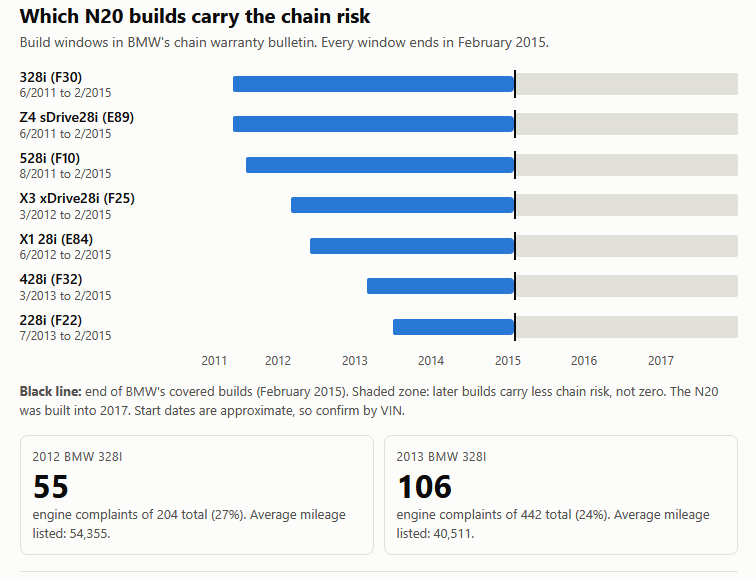
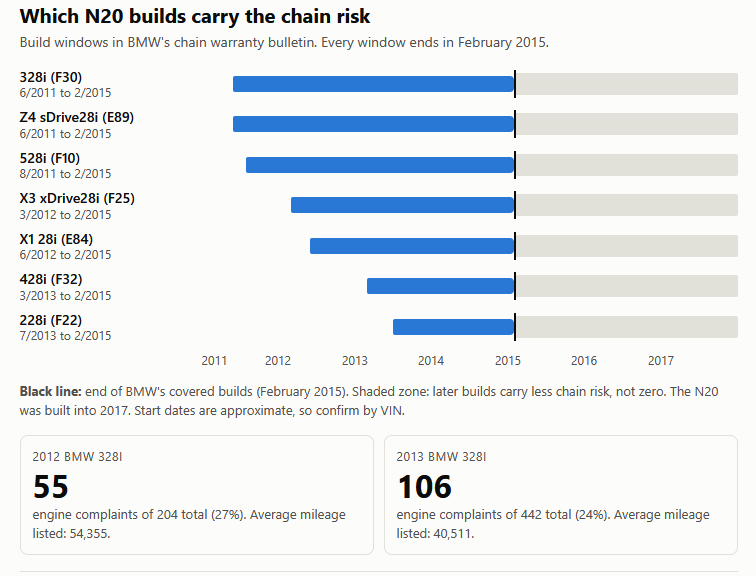
| Hits | N20 and N26 built from about 6/2011 to 2/2015 |
| BMW’s warning sign | A whine from the lower engine that rises with rpm |
| Typical repair | About $1,800 to $3,500 |
Which N20 Cars Carry the Chain Risk?
The chain risk sits in N20 and N26 cars built from mid 2011 (primarily model years 2012 to 2015) to February 2015, and the start date depends on when each model got the engine.
2. N20 Water Pumps Fail, and is there a Recall?
The N20 uses an electric water pump that can fail with little warning, and BMW recalled about 720,000 U.S. vehicles in August 2024 for a pump connector fault (NHTSA 24V-608).
How to Spot It: Watch for an overheating warning or a temperature spike, coolant loss or puddles near the front of the engine, weak cabin heat, and a cooling pump fault code on a scan. If the warning comes on, stop and switch off the engine, because a single overheat can damage the head gasket or cylinder head.
Fix: N20 water pumps usually tend to fail around 60,000–100,000 miles. If your car is past this range or you see any of the symptoms above. Get the cooling system checked before the next long drive, since one overheat can damage the head gasket.
| Hits | Many 2012 to 2018 models, depending on engine and model |
| Warning sign | Overheating warning, reduced power, coolant loss |
| Typical repair | Recall repair is free. I found no trustworthy price outside the recall |
Also Read: BMW B58
3. N20 Valve Cover and Valve Cover Gasket Oil Leaks
The N20 valve cover leaks because it is plastic with a rubber gasket, and heat cycling hardens the gasket and can warp the cover. A leaking valve cover starts as a burning smell, but the repair is sensitive: the plastic cover can crack if over-tightened, and the job disturbs the high-pressure fuel system, so who does it matters.
How to Spot: Look for a burning oil smell after a drive, oil residue on the top of the engine, or a falling oil level. A clogged PCV can add oil burning, which owners of the 2012 328i report in NHTSA complaints. Oil that reaches hot exhaust parts burns off, which is why the smell often shows up before any drips do.
Fix: Decide by the condition of the cover. If it is clean and flat, a new gasket kit does the job, at about $90 in parts. If it is warped, cracked or has a clogged PCV, replace the whole cover, at about $450. Plan on a full day of labor, and have the shop torque the bolts to spec, because over-tightening cracks the cover.
| Hits | Any N20, usually after years of heat cycles |
| Warning sign | Oil smell, oil residue on the engine, burning oil |
| Typical repair | Parts about $90 for the gasket kit or $450 for a cover, plus a full day of labor |
4. N20 Oil Filter Housing Gasket Leaks
Oil filter housing gasket leaks are a slow, front-of-engine oil leak that is cheap to fix early and messier the longer it runs. The housing is sealed to the engine by a rubber gasket. It is a real leak point on the N20, but the evidence for engine damage is thinner than the horror stories suggest.
Fix: Replace the oil filter housing gasket (OFHG) to stop oil leaks and prevent engine damage caused by oil dripping onto the serpentine belt.
Replacement pricing (US dollars):
- Parts: A gasket kit runs about $38 to $60
- DIY total: FCP Euro puts parts and fluids at about $120 to $140.
- Shop: Around $450 to $750 at an independent BMW specialist, and $650 to $1,200 at a dealer.
5. High-Pressure Fuel Pump (HPFP) Issues
The N20 high-pressure fuel pump is mostly a noise problem, and real pump failure is less documented. BMW traces the tick to mechanical vibration inside the pump. The pump is part of the high-pressure fuel system, so diagnose before you replace anything. A tick alone is usually harmless, while a tick with drivability symptoms is a different job.
How to Spot: Listen for a high-frequency tick from the engine bay that is audible inside and outside the car. Real pump trouble would show as hard starts, hesitation or fuel pressure codes, so treat those as a reason for a scan.
Fix: For the tick, BMW’s fix is a plastic acoustic cover that snaps on without removing any fuel lines, about 15 minutes as far as I know. It was covered under BMW’s new vehicle warranty, which has long since expired on these cars, so expect to pay for it.
| Hits | F30 built up to May 21, 2012 |
| Warning sign | High-frequency tick, audible inside and outside the car |
| Typical repair | Acoustic cover, covered by BMW’s new vehicle warranty |
6. N20 Turbocharger Wastegate Rattle
Wastegate rattle comes from wear or slack in the actuator rod, linkage or flapper, and on the N20 it is a thinner problem than its reputation suggests. It starts as a noise, but the repair is sensitive: adjusting the actuator wrongly can cause boost problems, and the rattle can eventually lead to turbo failure.
How to Spot: Listen for a metallic rattle at idle, especially on a cold start, and sometimes during light acceleration or deceleration. Weak turbo response or a check engine light can follow once control errors develop. The rattle is not always a sign of imminent failure, but the most serious report I found is a 2013 328i owner whose rusted actuator lever detached, causing a sudden loss of power.
Fix: Repair sources describe the steps in order of cost. First, check the heat shields and brackets for loose hardware. Then have the actuator adjusted, and replace the actuator if there is play in it. Only if that fails should the turbo be rebuilt or replaced.
| Hits | Any N20, no mileage pattern verified |
| Warning sign | Metallic rattle at idle, especially when cold |
| Typical repair | Adjust or replace the actuator. I found no verified price |
7. N20 Coolant System Issues
The N20 cooling system fails without much warning, and a single overheat can damage the head gasket or cylinder head. It uses an electric water pump and an electronically controlled thermostat, so there is no belt-driven pump slowing down to warn you. A separate 2024 recall (24V-608) covers a sealing fault in the pump’s electrical connector. It is a free fix, and you can check it by VIN.
How to Spot: Watch the temperature gauge and the heater first, as an unusual temperature rise points to poor coolant flow. Look for dried coolant crust at hose joints and the oil filter housing coolant lines, and check that the expansion tank level is not dropping.
Fix: BMW’s electric water pumps typically last 60,000-80,000 miles before needing replacement. After that, you may need to replace the failed pump or thermostat and get the lines and connectors around it checked while the system is open. A shop can pressure-test the system to find slow leaks before they turn into an overheat.
| Hits | Mostly tuned or higher-boost cars |
| Warning sign | Pop under boost, sudden power loss, limp mode, check engine light |
| Typical repair | Aluminum replacement pipe from a performance seller |
Also Read: BMW Inspection I vs Inspection II
BMW N20 Valvetronic problems
Valvetronic controls how much air the N20 takes in by changing how far the intake valves open, instead of relying only on the throttle. A motor turns an eccentric shaft that moves rocker arms that set valve lift, which the sensor reports to the engine computer. Valve lift also sets idle airflow, so a fault usually shows up as an idle problem first.
How to Spot: The usual symptoms are a rough idle or cold-start stumble, reduced power or limp mode, long cranking, erratic throttle response and a check engine light.
Fix: The technician checks the motor and sensor connectors for oil, the wiring, and the battery history. A flat or replaced battery can leave the system needing readaptation with a scan tool. After a repair, the system has to be calibrated with BMW software.
Other BMW N20 Problems to Watch For
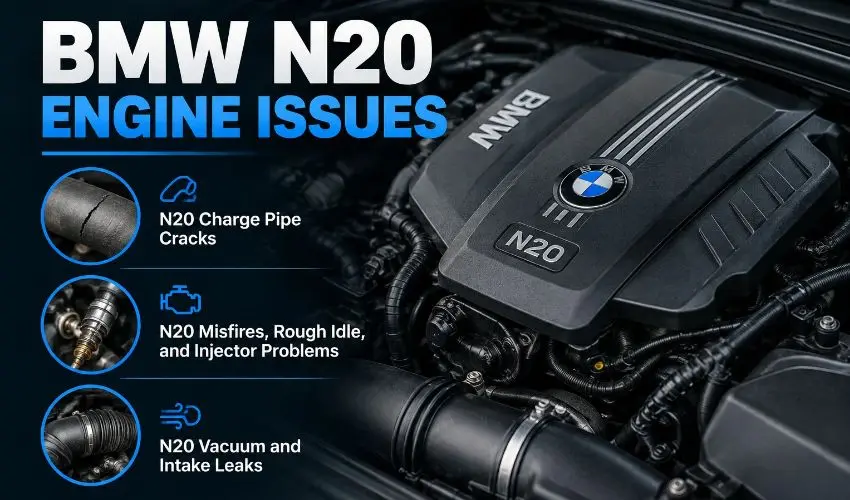
N20 charge pipe cracks
Problem: A cracked charge pipe lets boost air escape, but almost every source that calls it a common N20 weak point sells the replacement, and I found no BMW bulletin for stock cars. It’s still a real problem though.
How to Spot: Look for weak acceleration, a whistle or hiss under load, a check engine light, and sometimes a rough idle or limp mode. A smoke or pressure test confirms the leak, and a technician can back it up by comparing requested and actual boost and reading the fuel trims. The leak can also sit at the couplers, O-rings or clamps, not only the pipe.
Fix: Replace a cracked pipe, and replace worn couplers and O-rings at the same time. The options are a new factory plastic pipe or an aluminum and silicone upgrade.
N20 Misfires, Rough Idle, and Injector Problems
Problem: An injector fault code on an N20 does not mean the injector failed. BMW’s bulletin SI B12 38 14 blames an internal fault in the engine computer for cars built through January 31, 2015.
How to Spot: Look for an engine that will not restart after a short shutdown although the starter turns, one that starts and stalls, erratic running or lack of power, and a warning light. A misfire on a single cylinder points to the spark plug or coil instead.
Fix: For the bulletin fault, check the wiring, connectors and power supply first; replace the engine computer only if those pass, and do not replace the injectors. For a single-cylinder misfire, replace the plugs or the coil, and swap a coil to a neighboring cylinder to see whether the misfire follows it.
N20 Vacuum and Intake Leaks
Problem: An air leak can make an N20 idle rough and run lean, but I found no N20-specific pattern. The one N20-specific lead is the crankcase ventilation valve, which is built into the valve cover on many applications.
How to Spot: Look for whistling at idle, a rough idle, lean codes and high positive fuel trims. A smoke test finds the leak, and a code alone does not give its location.
Fix: Repair what the smoke shows. That means replacing the cracked hose, seal or coupler. If the torn part is the ventilation valve, the valve cover may need replacing.
Is the BMW N20 Reliable After 100,000 Miles?
It can be if the car has a documented timing chain replacement and consistent oil change records. Without both, it is a gamble.
Does Mileage tell you if an N20 is safe?
Not on its own. CarComplaints lists average mileages of 54,355 for the 2012 328i and 40,511 for the 2013 on its engine complaint pages, so reported trouble tends to come well before 100,000 miles. Those are averages among complaints, not failure rates. An original-engine N20 that passed 100,000 miles without an engine complaint has probably cleared the riskiest stretch, but that is no guarantee.
| Item | What I found |
|---|---|
| Chain job, if there is no invoice | $1,800 to $3,500 |
| Valve cover | $90 gasket kit or $450 cover in parts, plus a full day of labor |
| Spark plugs | $290 to $458 at a shop (RepairPal, 2013 328i) |
| Everything else | RepairPal’s yearly average for a 2013 328i is $736, typically $663 to $810 |
Is the Timing Chain Still Covered by BMW?
No. BMW’s chain warranty ran 7 years or 70,000 miles from the in-service date, and every covered car was out of coverage by 2023 at the latest. On a 100,000-mile car, a chain failure is your bill. Ask for an invoice showing the chain, guides, tensioner and oil pump drive chain were replaced. If the chain is original, have a BMW specialist assess it before you buy.
Should you Buy, Keep or Sell an N20?
It depends on which of three situations you are in, and the build date and chain history decide each one.
Your situation | What I would do |
|---|---|
| Buying to keep for years | Buy a car built after February 2015, or one with an invoice for the chain, guides and tensioner |
| Buying cheap for a few years | Add the chain job, $1,800 to $3,500, to the price. Walk away if the seller refuses a chain check |
| Already own one | Listen for the whine, run the VIN for the 2024 recall, and keep oil changes on time |
Frequently Asked Questions – BMW N20 Common Problems
A well-maintained N20 usually lasts 150,000 to 200,000 miles, and some reach 250,000. Neglected ones often develop serious problems much sooner, especially timing chain wear.
The earliest years, 2012 to 2014, have the most complaints, mainly because of weak timing chain guides. BMW improved the design in later years, so 2015 to 2017 models tend to be safer buys.
The N20 is less reliable than BMW’s inline-six engines like the N52 and the newer B58.
Change the oil every 5,000 to 7,500 miles, not at BMW’s long factory interval. Replace the water pump and thermostat before they fail, fix oil leaks early, and listen for a cold-start rattle. Replacing the timing chain kit before it fails is the best protection.
No. A stretched or slipping chain can jump timing and cause the pistons and valves to collide, which can destroy the engine. If you hear a rattle or see a check engine light, get it towed to a shop instead of driving it.