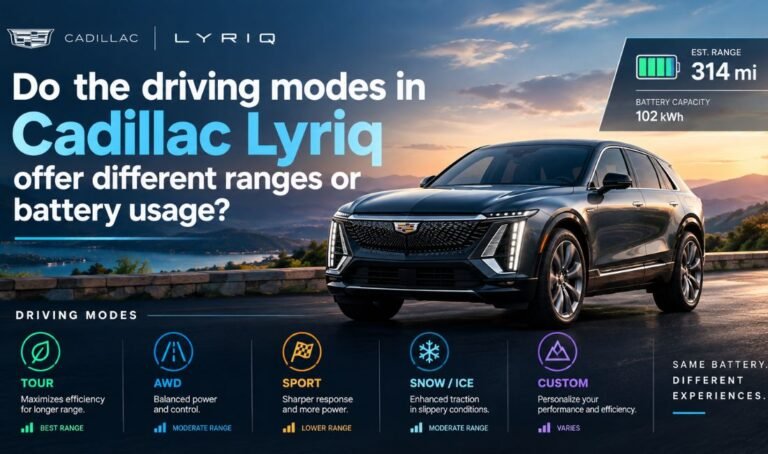

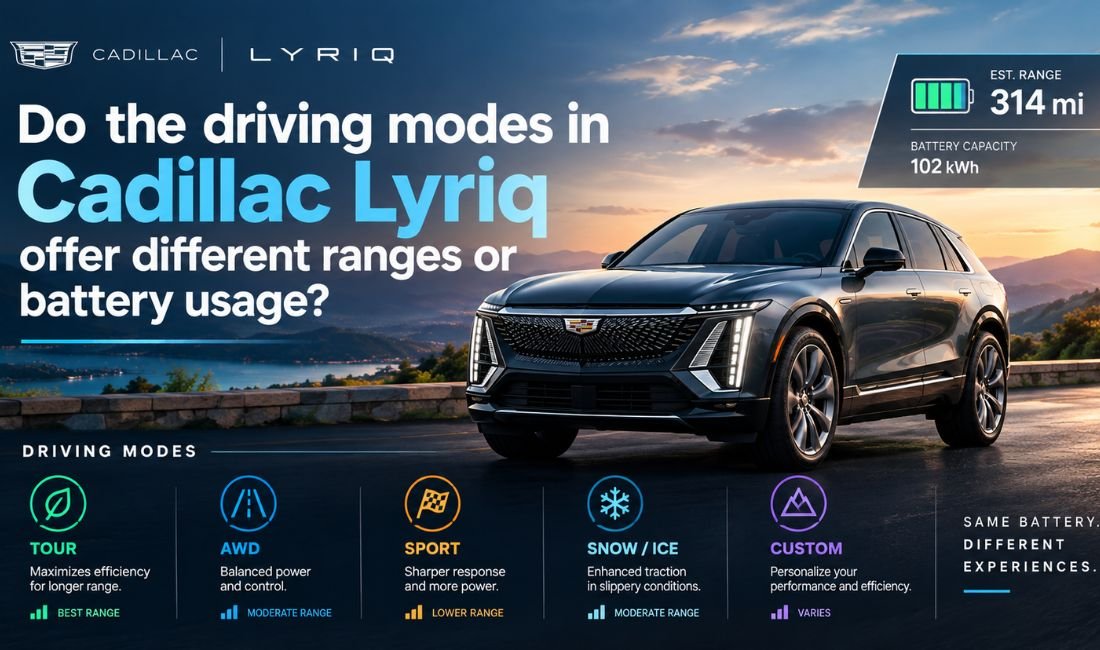
Yes, the Cadillac LYRIQ’s driving modes can affect battery usage and driving range, but they don’t change the battery’s capacity. The 2024–2026 LYRIQ offers EPA-estimated ranges of approximately 314–326 miles for rear-wheel-drive (RWD) models and around 307 miles for all-wheel-drive (AWD) models, depending on the model year and configuration.
Tour mode: Ideal for everyday driving and consistent efficiency.
Sport mode: May use more energy during aggressive acceleration.
Snow/Ice mode: Adjusts power delivery to improve traction on slippery roads.
My Mode: Allows drivers to customize certain driving settings.
There is no official, fixed range difference between driving modes. For the best practical range, use Tour mode, accelerate smoothly, and maintain a steady speed. Actual battery consumption depends on driving habits, speed, weather, road conditions, and climate control.
Need to Know
- Battery capacity never changes — every driving mode draws from the same full battery; only the rate of energy use differs.
- Tour mode maximizes range — smoother throttle response and stronger regenerative braking make it the most efficient everyday choice.
- Sport mode costs you range for performance — quicker throttle response and more aggressive power delivery drain the battery faster, especially in stop-and-go driving.
- Snow/Ice mode prioritizes safety, not efficiency — it adjusts power and traction control for stability, which can slightly increase energy use.
- Climate control and driving style matter as much as the mode itself — cold-weather heating and aggressive acceleration can affect range more than which mode you’re in.
How the Battery and Driving Modes Actually Work Together
The Cadillac Lyriq is General Motors’ flagship electric SUV, built on GM’s Ultium platform with a 102 kWh usable battery. The rear-wheel-drive version carries an EPA rating of 326 miles, the all-wheel-drive version is rated at 319 miles, and the high-performance Lyriq-V trades some of that range for power at 285 miles. Those numbers come from a lab cycle that assumes moderate, steady driving, not how anyone actually drives on a Tuesday.
This is where driving modes come in. They don’t add or remove usable kilowatt-hours from the battery; instead, they reprogram how the motor, throttle mapping, regenerative braking, suspension, and even climate systems behave. That difference in behavior is what ultimately shows up as a difference in range, even though the battery underneath is untouched.
Also Read: Luxury Cars for $30k
The Driving Modes Available in the Lyriq
The Cadillac Lyriq typically offers a handful of selectable drive modes, accessible through the center touchscreen or a dedicated control:
- Tour Mode – the default, everyday setting
- Sport Mode – tuned for spirited, responsive driving
- Snow/Ice Mode – tuned for low-traction conditions
- My Mode – a customizable profile where drivers can mix and match settings
How Each Mode Affects Battery Range
| Mode | What Changes | Effect on Range |
|---|---|---|
| Tour | Normal throttle response, stronger regen braking | Best for consistent efficiency |
| Sport | Aggressive acceleration, quicker power delivery | Uses more energy with spirited driving |
| Snow/Ice | Traction control priority, conservative power | Can increase consumption in slippery conditions |
| My Mode | Customizable settings | Depends on configuration |
Tour Mode: Best for Efficiency
Tour mode gives the best real-world mileage of any drive mode in the Lyriq. Because the throttle mapping is smoother and less eager, the motor rarely draws the big bursts of power that sportier settings ask for. That’s why most owners spend nearly all their driving time here, whether they’re commuting, running errands, or heading out on a road trip.
Sport Mode: Performance Over Range
Sport mode costs you range in exchange for a quicker, more responsive Lyriq. It sharpens throttle response and makes the car feel noticeably eager off the line, and that responsiveness comes from drawing more power, more quickly, from the battery. Aggressive acceleration is one of the fastest ways to drain any EV, so drivers who lean on Sport regularly, especially in city driving, will notice a shorter range than they’d get in Tour.
Snow/Ice Mode: Built for Grip, Not Mileage
Snow/Ice mode is built to keep you planted on slick roads, not to stretch your range. It softens throttle sensitivity and manages power delivery more conservatively to keep the wheels from slipping, particularly on AWD models. Because the system is prioritizing traction and stability over efficiency, energy use can shift slightly compared to Tour, though some drivers report similar or even slightly better range in winter conditions here, mostly because the smoother inputs it encourages avoid the kind of hard acceleration that wastes energy anyway.
My Mode: Efficiency on Your Terms
My Mode’s effect on your range depends entirely on how you set it up. It hands you the dials directly, letting you tune steering weight, throttle response, and other preferences instead of accepting a preset. Dial in a gentle throttle and maximum regen and you’ll land close to Tour’s efficiency; chase responsiveness instead and you’ll use energy more as Sport does.
Differences Between Driving Modes
| Mode | Efficiency vs. Tour | Approx. range (326-mi baseline) |
|---|---|---|
| Tour | Baseline — best efficiency | ~275–326 mi |
| Sport | 5–15% lower | ~265–280 mi |
| Snow/Ice | 3–8% lower (dry roads) | ~300 mi (less in cold) |
| My Mode | Varies with settings | ~265–326 mi |
These owner-reported figures aren’t lab-verified, so treat this as a general pattern rather than a guarantee. The direction holds consistently across owner data: Tour saves energy, Sport spends it, and Snow/Ice spends a little more in exchange for grip.
Does the Battery Capacity Actually Change?
No, Switching Modes doesn’t touch your battery capacity. Switching drive modes does not lock away or unlock a portion of the battery. The full pack is available no matter which mode you’re in. What changes is the rate and manner in which that energy gets used: throttle mapping, regen strength, and power delivery curves all shift, but the underlying energy pool stays exactly the same size.
Also Read: Best Electric Convertible Cars
The Factors That Matter More Than Your Drive Mode
Drive mode is a smaller factor than most people assume. A few things matter more:
Highway Speed
Sustained high speeds increase aerodynamic drag more than any mode can compensate for. Interestingly, the Lyriq handles this better than a lot of EVs. Consumer Reports clocked an AWD Lyriq at 315 miles on a 70 mph highway loop, essentially matching its EPA rating, and InsideEVs got an RWD Lyriq to 330 miles at the same speed, beating its rating by nearly 20 miles. Push into the high 70s and low 80s, though, and that cushion disappears fast.
City Driving
In city driving, with frequent acceleration and braking, Drive mode plays a bigger role here, since Tour mode’s smoother throttle response and stronger regen make the most of every stop, while Sport mode’s quicker throttle input burns through that advantage faster in stop-and-go traffic.
Wheel and tire size
Larger wheels look great, but they add weight and rolling resistance that quietly eat into range no matter which drive mode you’re in. Sticking with smaller factory wheels or dedicated winter tires can noticeably improve both range and grip.
Driving style
How you drive matters more than any mode setting. Hard acceleration and sustained high speeds drain the battery faster than switching between Tour, Sport, or Snow/Ice ever will, so smooth, steady inputs preserve range better than the mode label does.
Regenerative Braking and One-Pedal Driving
Regenerative braking is one of the biggest levers connecting drive mode to range. In efficiency-oriented modes, the system captures more kinetic energy during deceleration and feeds it back into the battery, effectively adding range back with every stop. The Lyriq’s one-pedal driving feature lets the car slow significantly just by lifting off the accelerator.
Sport mode typically dials back some of this regenerative aggressiveness in favor of a more traditional coasting feel, which is part of why it tends to use more energy overall.
Does Cadillac Publish Official Range?
No. Cadillac does not publish an official percentage or range difference between Tour, Sport, and Snow/Ice modes. The company confirms that the Lyriq has a 102 kWh usable battery and published EPA range estimates, but does not break down mode-specific range penalties.
Any claimed percentage difference (such as “Sport mode costs 5-15% range”) comes from owner reports and real-world testing, not from Cadillac specifications. This is an important distinction because it means mode differences vary based on individual driving style, weather, and conditions rather than a fixed factory specification.
What Is the Actual Range of the Cadillac Lyriq?
This is the number most readers want, and the range you will actually get. So here it is, straight from Cadillac’s current specs page.
| Lyriq | Battery | Rated Range |
|---|---|---|
| RWD (single motor) | 102 kWh | Up to 326 mi |
| AWD (dual motor) | 102 kWh | 307 mi |
| AWD, high performance | 102 kWh | 285 mi |
Larger wheel packages, sustained highway speeds, and cold weather all pull real-world numbers below these ratings, while gentle city driving with strong regenerative braking can sometimes match or slightly beat them.
City Driving vs. Highway Driving: Where Mode Matters Most
The impact of drive mode isn’t uniform across every kind of trip. In city driving, with frequent acceleration and braking, the difference between Tour and Sport mode tends to be more noticeable, since regenerative braking and throttle smoothness get used constantly.
On the highway, where speed is more consistent and the car isn’t accelerating and decelerating as often, aerodynamic drag and cruising speed become the dominant factors in range, meaning the gap between drive modes narrows, even though Tour mode still generally holds a slight efficiency edge.
Cadillac LYRIQ Range in Summer vs Winter
In mild weather, most LYRIQ owners come close to the official rating, often landing within 5 to 10 percent of it during normal city and highway driving. In winter, that gap widens considerably, with owners typically losing 20 to 35 percent of their range once temperatures drop below freezing.
| Season | Typical Real-World Range | |
|---|---|---|
| Summer / mild weather | 292 to 311 mi | Close to rated range with normal driving |
| Cool weather (5°C to 15°C) | 261 to 286 mi | Minor efficiency loss, light heater use |
| Winter (below 0°C) | 199 to 249 mi | Heater and cold battery both draw extra energy |
| Extreme cold (below -15°C) | 155 to 199 mi | Worse on short trips where the battery never warms up |
Why Does the Cadillac LYRIQ Lose Range in Winter?
The Cadillac LYRIQ loses winter range mainly because cold temperatures slow down the battery’s chemistry and because cabin heating draws power from the same pack that drives the wheels.
A cold battery simply can’t move energy as efficiently as a warm one. Below freezing, the chemical reactions inside the pack slow down, so the battery has to spend some of its own energy warming itself before it can deliver full power to the motor.
Cold, dense winter air also increases aerodynamic drag, which means the car needs more energy to hold highway speed than it would on a mild day.
Tire pressure drops in cold weather too, and lower pressure increases rolling resistance, quietly reducing efficiency even before you factor in snow or ice.
None of this is specific to Cadillac. Every EV loses range in winter for the same physical reasons. The LYRIQ’s heat pump-based climate system and liquid-cooled battery help limit the damage, but they don’t cancel it out entirely.
How to Get the Most Range Out of Your Lyriq
- Stick to Tour mode for daily commuting and long-distance trips
- Lean into one-pedal driving and strong regenerative braking settings
- Precondition the cabin while still plugged in during hot or cold weather
- Save Sport mode for shorter drives or when performance matters more than range
- Use Snow/Ice mode only when conditions call for it, not as a daily default
How Many Miles Will a Cadillac Lyriq Battery Last?
Most Lyriq batteries usually outlast the rest of the car if they’re treated reasonably well. Cadillac backs the high-voltage pack with an 8-year, 100,000-mile warranty in the US, and if capacity drops below roughly 70 to 75 percent of new within that window, GM will typically repair or replace it. Early real-world data backs this up: 2022 and 2023 Lyriqs with 20,000 to 30,000 miles on them are commonly showing less than 5 percent capacity loss, well ahead of the pace that warranty threshold implies.
At that rate, a typical owner driving 12,000 to 15,000 miles a year is looking at 10 to 15 years, and well over 150,000 miles, before range loss becomes something they’d actually notice day to day.
How you charge matters more than how far you drive. Keeping the battery mostly between 20 and 80 percent, avoiding constant DC fast charging, and parking out of extreme heat all slow the aging process meaningfully. Do the opposite consistently and you can pull that timeline forward, potentially into the warranty window itself. None of this is tied to driving modes either: it happens in the background no matter whether you’re in Tour, Sport, or Snow/Ice.
Cadillac Lyriq vs Optiq: Which Has Better Battery Range?
The Cadillac LYRIQ has the longer range of the two, rated up to 502 km (312 miles) versus the Optiq’s roughly 486 km (302 miles), thanks to a larger battery pack.
The gap comes down to size and positioning. The LYRIQ uses a roughly 102 kWh Ultium battery in a larger midsize SUV body, while the Optiq is Cadillac’s smaller, more affordable EV, built around an 85 to 90 kWh pack. That size difference explains most of the range gap, even though both vehicles share the same Ultium platform and similar efficiency tech.
In everyday terms, the difference is smaller than the numbers suggest. Both vehicles lose range in the same ways in winter, roughly 20 to 35 percent in freezing temperatures, so a LYRIQ still tends to hold a slight real-world edge on long winter drives simply because it starts with more range to lose. For buyers who mainly drive around town, the Optiq’s shorter range is rarely a dealbreaker, while the LYRIQ makes more sense for those who regularly cover longer distances or want a bigger buffer once winter cuts into range.
Frequently Asked Questions – Cadillac Lyriq’s Driving Modes
Yes, it’s fine to switch drive modes while driving the Lyriq. The system is designed to change on the fly without any risk to the car or the battery, so you can move between Tour, Sport, and Snow/Ice mid-trip as conditions or your mood change.
No. Driving modes never change the battery’s actual capacity or the EPA range rating, they only affect how quickly that stored energy gets used.
Most owners see somewhere between 240 and 300 miles in everyday driving, close to the EPA ratings of 326 miles (RWD) and 319 miles (AWD). Sustained highway speeds and cold weather can pull that down into the low 200s, while gentle city driving with strong regen can match or beat the EPA number.
Tour mode is best for long-distance driving. It keeps throttle response smooth and regenerative braking strong, which gives you the most consistent and longest real-world range on a road trip.
You should not charge your LYRIQ to 100% for daily use. Keeping the battery mostly between 20 and 80 percent helps it age more slowly. Charging to 100% occasionally before a long trip is fine and won’t meaningfully hurt the pack.