You’re approaching an intersection when you see a red-and-white triangular YIELD sign. Another car is coming from the side, but it’s still some distance away. Do you stop completely? Keep moving? Or wait until the other driver passes?
In simple terms, yield means giving the right-of-way to another vehicle, cyclist, or pedestrian when required. You should approach carefully, slow down as needed, look for conflicting traffic, and be prepared to stop. If someone else has the right-of-way, let them proceed before you.
If the way is clear and you can continue safely, a yield sign does not automatically require a complete stop.
That said, yielding isn’t just another word for slowing down. What really matters is recognizing who should go first and avoiding interference with road users who have the right-of-way.
- What Does Yield Mean in Driving Terms?
- What Does Yield Mean in Driving in Simple Terms?
- Does Yield Mean I Have to Stop?
- Does Yield Mean to Wait?
- What Does “Yield the Right-of-Way” Mean in Driving?
- What Does a Yield Sign Mean in Driving?
- What Does Yield Mean in Driving? A Simple Example
- Yield Sign vs. Stop Sign: What’s the Difference?
- What Does a Yellow Yield Sign Mean?
- What Does a Yield Ahead Sign Mean?
- Where Do Drivers Commonly Need to Yield?
- How Does Yielding Work at a Roundabout?
- What About Yielding When Merging?
- Why Drivers Get Yield Signs Wrong
- What Happens If You Reach a Yield Sign?
- What Happens If You Physically Hit a Yield Sign?
- What Happens If Drivers Don’t Yield?
- A Simple Trick for Remembering What Yield Means
- The Bottom Line
- Frequently Asked Questions
What Does Yield Mean in Driving Terms?
In driving terms, yield means allowing another road user with the right-of-way to proceed before you.
For example, imagine you’re entering a busier road from a smaller street controlled by a YIELD sign. A vehicle is approaching on the main road and is close enough that pulling out would force its driver to brake. You should yield.
Slow down or stop, allow the vehicle to pass, check the road again, and enter when you have a safe opening. If the road is clear, however, you can generally continue after checking that it’s safe.
A useful way to remember the process is: Slow down → Look → Give way when required → Proceed when safe.
The exact traffic laws governing right-of-way can vary by state and situation, but this basic principle is consistent with how yield control works on U.S. roads.
What Does Yield Mean in Driving in Simple Terms?
Forget the technical language for a moment. Yield basically means: let the other person go first when they have the right-of-way.
Suppose you’re approaching a roundabout. Vehicles are already circulating inside it. Instead of entering immediately and making another driver brake, you wait for a safe opening. That’s yielding.
Now imagine you approach the same roundabout and there’s no conflicting traffic. You still check carefully, but once you determine that entering is safe, you can proceed. That’s also why drivers shouldn’t automatically treat YIELD and STOP signs as if they mean the same thing.
Also Read: Do the driving modes in Cadillac Lyriq offer different ranges or battery usage?
Does Yield Mean I Have to Stop?
No, a YIELD sign does not always mean you have to come to a complete stop.
When you approach one, slow down as required and check for vehicles, pedestrians, cyclists, and other conflicting road users. Be prepared to stop. If another road user has the right-of-way and proceeding would interfere with them, you may need to stop and wait.
But if the way is clear and you can proceed safely, you normally do not have to make a complete stop simply because a YIELD sign is present.
Think about the difference this way: STOP sign: Stop first, then determine when it’s safe to proceed. YIELD sign: Approach carefully, determine whether you need to give way, and stop if necessary.
If your view is blocked by trees, parked vehicles, buildings, or another obstruction, you may need to slow significantly or stop before you can determine whether it’s safe to continue.
Does Yield Mean to Wait?
Sometimes. If another road user has the right-of-way, yielding can mean waiting until that person has passed or until a safe gap appears.
But yielding does not mean you must sit stationary every time you see the sign. You might approach a yield-controlled entrance, reduce your speed, see a vehicle pass ahead of you, and adjust your speed so that you enter safely behind it without ever coming to a complete stop.
The important question isn’t “Did I stop?” It’s “Did I safely give the right-of-way to the person who was entitled to proceed?”
What Does “Yield the Right-of-Way” Mean in Driving?
Right-of-way helps determine who is allowed to proceed first when vehicles, pedestrians, cyclists, or other road users meet. When you’re told to yield the right-of-way, you’re being told to let the road user who should go first proceed before you.
Imagine you’re entering another road and a vehicle is already approaching in the traffic stream you need to enter. If pulling out would make that driver brake hard or take evasive action, you haven’t given them the space they need. Instead, wait for an appropriate opening.
The core idea is simple: don’t move into a conflicting path when another road user has priority and your movement would interfere with them.
What Does a Yield Sign Mean in Driving?
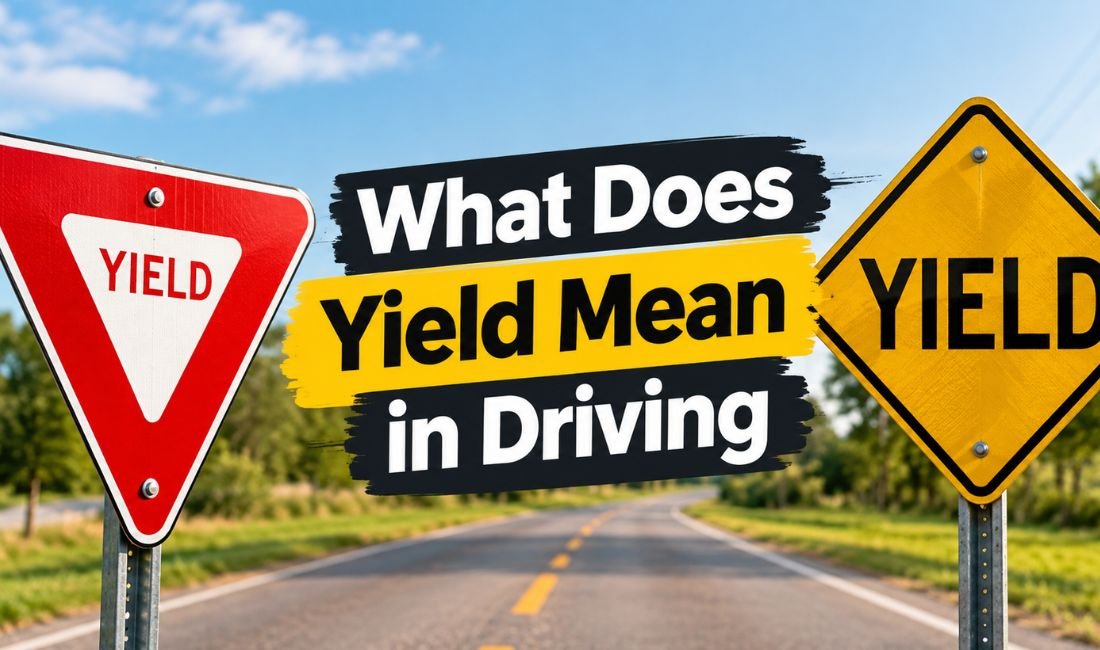
The standard YIELD sign used in the United States is an inverted triangle with a red border, white center, and red YIELD lettering. Its distinctive triangular shape makes it recognizable even from a distance.
When you encounter one, reduce your speed as necessary, observe the traffic situation, and give the right-of-way to conflicting road users when required.
You may encounter yield control at roundabout entrances, certain intersections, channelized right turns, some roadway entrances, and other locations where one traffic movement needs to give way to another.
What Does Yield Mean in Driving? A Simple Example
You’re approaching a T-intersection with a YIELD sign. A car is traveling along the road you want to enter. If you pull out now, that driver would need to brake to avoid you. So you slow down and wait.
The car passes. You look in both directions again, see that there’s a safe opening, and enter the road. You just yielded the right-of-way.
At the same intersection with no conflicting traffic, you can approach, slow down, look carefully, and proceed when safe without making an unnecessary full stop.
Yield Sign vs. Stop Sign: What’s the Difference?
Yield and stop signs both control right-of-way, but they require different actions.
A STOP sign requires a complete stop at the proper stopping point. After stopping, you check for traffic and proceed when permitted and safe.
A YIELD sign does not automatically require a complete stop. Instead, approach carefully, slow down as needed, identify conflicting traffic, and stop when necessary to yield.
A STOP sign is a red octagon. A YIELD sign is a red-and-white inverted triangle. Slowing down alone is not enough at a yield sign if another road user has the right-of-way and you need to let them proceed.
What Does a Yellow Yield Sign Mean?
The standard modern U.S. YIELD sign is red and white, not yellow. Older U.S. yield signs historically used a yellow design, which is one reason people may still associate the color yellow with yielding.
You may also encounter yellow warning signage related to an upcoming yield condition. Warning signs and actual regulatory YIELD signs serve different purposes.
The easiest rule for modern U.S. roads is: Red-and-white inverted triangle = YIELD sign.
What Does a Yield Ahead Sign Mean?
A YIELD AHEAD warning tells you that a yield-controlled location is coming up. That gives you time to prepare before reaching the actual YIELD sign.
A warning sign alerts you to what is ahead. The actual YIELD sign establishes the yield control at the location where it applies. As you approach, pay attention to traffic conditions so you aren’t forced into a sudden decision at the yield point.
Where Do Drivers Commonly Need to Yield?
Yielding isn’t limited to situations where you see a freestanding YIELD sign. Right-of-way rules can require drivers to give way in many situations, depending on state law and the traffic controls present.
One common example is entering a roundabout. Intersections, certain turns, roadway entrances, and interactions with pedestrians can also involve yielding.
Because exact rules can differ between states and roadway designs, always follow posted signs, traffic signals, pavement markings, and your state’s driving laws.
How Does Yielding Work at a Roundabout?
As you approach a roundabout, reduce your speed and watch for pedestrians, cyclists, and circulating traffic as applicable. At the entrance, follow the YIELD sign and give way to conflicting traffic already circulating in the roundabout.
If there’s a safe gap, enter. Once inside, follow lane markings and signs for your intended exit. Avoid entering so aggressively that a circulating driver has to brake or react suddenly.
What About Yielding When Merging?
Merging can be confusing because roadway designs and traffic controls vary. If your approach is controlled by a YIELD sign, follow that sign and give way to conflicting traffic as required.
When changing lanes, make sure the lane you want to enter is clear and that the maneuver can be completed safely. Don’t assume every merge works exactly the same way; signs, signals, lane markings, and state laws determine how a particular location should be handled.
Why Drivers Get Yield Signs Wrong
Drivers commonly make two opposite mistakes: treating YIELD as if it means STOP every time, or treating it as though it means slow down slightly and keep going no matter what.
Neither approach captures the full meaning. If conflicting traffic is close, you may need to stop. If the path is clearly open, you may be able to continue after slowing and checking. If visibility is poor, you may need to slow much more or stop so you can properly assess the road.
A yield sign requires judgment based on right-of-way and safety, not one identical action in every situation.
What Happens If You Reach a Yield Sign?
When you reach a YIELD sign, reduce your speed as necessary, look for conflicting vehicles, pedestrians, and cyclists, determine who has the right-of-way, stop if necessary to let them proceed, check again, and continue when it is safe.
The amount you need to slow depends on the road, visibility, traffic, and other conditions. The goal is to give yourself enough time to understand the situation and react safely.
What Happens If You Physically Hit a Yield Sign?
If your vehicle physically strikes a traffic sign, treat the incident as a collision. Get yourself and others out of immediate danger if possible, check for injuries, and follow the crash-reporting and property-damage requirements that apply where the incident occurred.
A damaged traffic sign can also create a hazard for other road users, so the appropriate authorities may need to be notified. Requirements differ by jurisdiction, so follow applicable state and local law.
What Happens If Drivers Don’t Yield?
Failing to yield can cause serious conflicts because two road users may attempt to occupy the same space at the same time. An approaching driver may be forced to brake suddenly or swerve, and the consequences can be especially serious for pedestrians, cyclists, and motorcyclists.
Failure-to-yield violations and penalties are governed by state and local laws, so there isn’t one nationwide fine that applies everywhere. If a failure to yield contributes to a crash, the circumstances may also be relevant when law enforcement, insurers, or courts determine what happened.
A Simple Trick for Remembering What Yield Means
Remember four words: Slow. Look. Give way. Go.
Slow enough to understand the traffic situation. Look for vehicles, cyclists, pedestrians, and other potential conflicts. Give way to road users who have the right-of-way. Go when you can proceed safely.
There’s no fixed number of seconds you must wait at every yield sign because every traffic situation is different.
The Bottom Line
So, what does yield mean in driving? It means giving the right-of-way to another road user when required. Slow down as necessary, look for conflicting traffic, be prepared to stop, and proceed only when it is safe.
The easiest mistake is thinking that YIELD always means “stop.” It doesn’t. The opposite mistake is thinking it only means “slow down.” That isn’t quite right either.
A STOP sign tells you that you must stop. A YIELD sign tells you to give the right-of-way and stop when necessary.
Remember the simple routine: Slow → Look → Give way → Go when safe. Once you understand that principle, yield signs become much easier to handle whether you encounter one at an intersection, roundabout, roadway entrance, or another yield-controlled location.
Frequently Asked Questions
Yield means giving the right-of-way to another road user when required. Slow down as necessary, be prepared to stop, let conflicting traffic proceed, and continue when it is safe.
In driving terms, yield means allowing a vehicle, pedestrian, cyclist, or other road user with the right-of-way to proceed before you when your paths conflict.
The simplest explanation is: let the other person go first when they have the right-of-way.
Reduce your speed enough to assess the roadway safely. If an obstruction prevents you from determining whether the path is clear, you may need to stop before proceeding.